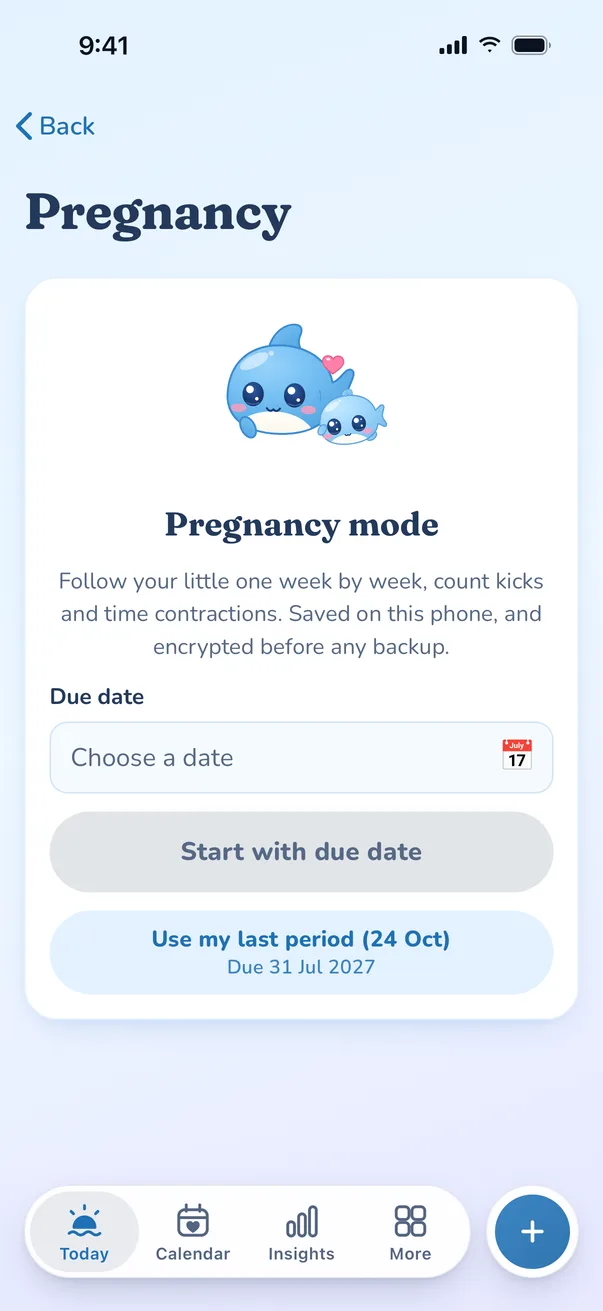

How does the due date calculator work?
- From your last period: we add 280 days (40 weeks) to the first day of your last period (Naegele's rule), then adjust for your cycle length if it isn't 28 days.
- From conception: we add 266 days (38 weeks).
- From an IVF transfer: day-5 embryo transfer plus 261 days, or day-3 plus 263 days.
- Weeks of pregnancy are counted from the first day of your last period, so you're "2 weeks pregnant" around conception.
Your scan date wins
In the UK, most people are offered a dating scan between 10 and 14 weeks. Measuring the baby is a more reliable way to date a pregnancy than counting from a period, so if your scan gives a different date, use that one (ACOG, NHS).
Why weeks are counted from your period
Pregnancy is dated from the first day of your last period, about two weeks before conception. That's why you're already "4 weeks pregnant" around the time a period would be due. It feels odd, but it means everyone counts the same way.
For what to expect along the way, see pregnancy trimesters explained. If you have bleeding, strong pain or you're worried at any point, contact your midwife, GP or maternity unit straight away.
How cycle length changes your due date
Naegele's rule assumes a 28-day cycle with ovulation on about day 14. If your cycles are longer, you probably ovulated later, so your due date moves later by the same number of days. Shorter cycles move it earlier. The calculator makes this adjustment for you.
| Usual cycle length | Days added | Example: last period 1 March |
|---|---|---|
| 24 days | 276 days | 2 December |
| 26 days | 278 days | 4 December |
| 28 days | 280 days | 6 December |
| 30 days | 282 days | 8 December |
| 32 days | 284 days | 10 December |
| 35 days | 287 days | 13 December |
If your cycles are irregular, a period-based date is less reliable, and the dating scan matters even more. The same applies if you got pregnant soon after stopping hormonal contraception or while breastfeeding.
Preterm, full term and overdue
Your due date marks 40 weeks, but only a small minority of babies arrive on that exact day. Natural pregnancy length varies by up to five weeks between people, even when ovulation day is known (Jukic et al., 2013). That's why it helps to think of a window rather than a date.
| Weeks of pregnancy | Name |
|---|---|
| Before 37+0 | Preterm (premature) |
| 37+0 to 38+6 | Early term |
| 39+0 to 40+6 | Full term |
| 41+0 to 41+6 | Late term |
| 42+0 onwards | Post-term |
These are the ACOG definitions. In the UK, the NHS usually describes any birth from 37 to 42 weeks as "at term". If you reach 41 weeks, your midwife will talk to you about induction of labour, which NICE recommends offering from then (NICE NG207).
Key dates in NHS pregnancy care
Once you know your due date, you can roughly plan the appointments ahead. Exact timings vary between areas and depend on whether this is your first baby.
| Week | What usually happens |
|---|---|
| By 10 | Booking appointment with a midwife: health history, blood tests, and advice on folic acid and vitamin D |
| 10 to 14 | Dating scan, which sets your due date; screening for some conditions may be offered |
| 16 | Midwife check: blood pressure, urine and test results |
| 18 to 20+6 | Mid-pregnancy (anomaly) scan |
| 25 to 41 | Regular checks of blood pressure, urine and your baby's growth; more often in a first pregnancy |
| 41 | If you haven't given birth, a membrane sweep and induction are discussed |
See the NHS's guide to your antenatal appointments, and our walk-through of the NHS pregnancy journey. Already past 36 weeks? Read about the signs of labour.
Due dates after IVF
With IVF, the embryo's age on transfer day is known, so the date doesn't depend on your last period. A day-5 blastocyst transfer adds 261 days, and a day-3 transfer adds 263 days (ACOG). Our IVF due date calculator handles fresh and frozen transfers, and IVF and fertility treatment explains the process.
What to do next
- Take folic acid. The NHS advises 400 micrograms a day until 12 weeks, and 10 micrograms of vitamin D a day. See prenatal vitamins.
- Book in with a midwife. Aim to have your booking appointment by 10 weeks.
- Check what to avoid. Our guide to foods to avoid in pregnancy keeps it calm and practical.
- Find your week. The pregnancy week calculator tells you exactly how far along you are today.
When to see a doctor
- Any bleeding from the vagina in pregnancy: contact your midwife, GP or maternity unit the same day.
- Pain low in your tummy, especially on one side, pain at the tip of your shoulder, or feeling faint in early pregnancy. These can be signs of an ectopic pregnancy and need urgent care.
- You haven't been booked in with a midwife by about 10 weeks. In much of the UK you can self-refer without seeing a GP first.
- A bad headache, problems with your vision, or sudden swelling of your face, hands or feet, especially after 20 weeks. These can be signs of pre-eclampsia.
- Your baby's movements slow down, change or stop. Call your maternity unit straight away rather than waiting until the next day.
- Fluid leaking from your vagina, a high temperature, severe itching (especially on your hands and feet), or vomiting so much that you can't keep fluids down.
In the UK you can call NHS 111 for advice, any time. In an emergency call 999 (UK) or 911 (US).
Questions people ask
How is a due date calculated?
Most often from the first day of your last period plus 40 weeks (280 days). A dating scan, usually between 10 and 14 weeks in the UK, then confirms or adjusts it.
Will my baby really arrive on the due date?
Probably not on the exact day. Most babies arrive in the weeks either side of it. Natural pregnancy length can vary by several weeks between people (Jukic, 2013).
What counts as full term?
From 37 weeks to 41 weeks and 6 days. We show this window as well as the single date.
How do trimesters work?
The first trimester runs to the end of week 13, the second from week 14 to the end of week 27, and the third from week 28 to birth.
I'm not sure when my last period was.
That's really common. Use conception date if you know it, or wait for your dating scan, which is more reliable than any calculator.
If my last period started on 1 January, when is my baby due?
Around 8 October, assuming a 28-day cycle: 1 January plus 280 days. With a 32-day cycle, add 4 more days (about 12 October). Your dating scan may move this by a few days.
How many weeks pregnant am I?
Count the full weeks since the first day of your last period. If it started 8 weeks and 3 days ago, you are 8+3 weeks pregnant, even though conception was only about 6 weeks ago. The calculator above does the counting for you.
My scan gave a different due date. Which one is right?
Use the scan date. UK guidance is to date the pregnancy from the baby's crown-rump length at the dating scan, between about 10 and 14 weeks, because ovulation does not always happen on day 14 (NICE NG201). Once a first-trimester scan has set your date, it usually isn't changed by later scans (ACOG).
What happens if I go past my due date?
Around 40 to 41 weeks your midwife will talk to you about a membrane sweep, and NICE recommends offering induction of labour from 41 weeks. You can choose to wait with extra monitoring instead (NICE NG207, NHS).
Does IVF change how the due date is worked out?
Yes. With IVF the embryo's age is known exactly, so the date comes from the transfer: 266 days minus the embryo's age in days. That's 261 days after a day-5 transfer and 263 days after a day-3 transfer (ACOG). Your clinic will confirm it.
Is anything I enter sent to you?
No. The calculation runs in your browser and nothing is stored or sent.
Sources
- ACOG Committee Opinion 700: Methods for estimating the due date
- NHS: Due date calculator
- NHS: 12-week scan
- NICE NG201: Antenatal care (2021)
- ACOG Committee Opinion 579: Definition of term pregnancy
- NICE NG207: Inducing labour (2021)
- NHS: If your baby is overdue
- Jukic AM et al. Length of human pregnancy and contributors to its natural variation. Human Reproduction, 2013
Written by the Splash team · Sources checked Oct 2026 · Updated