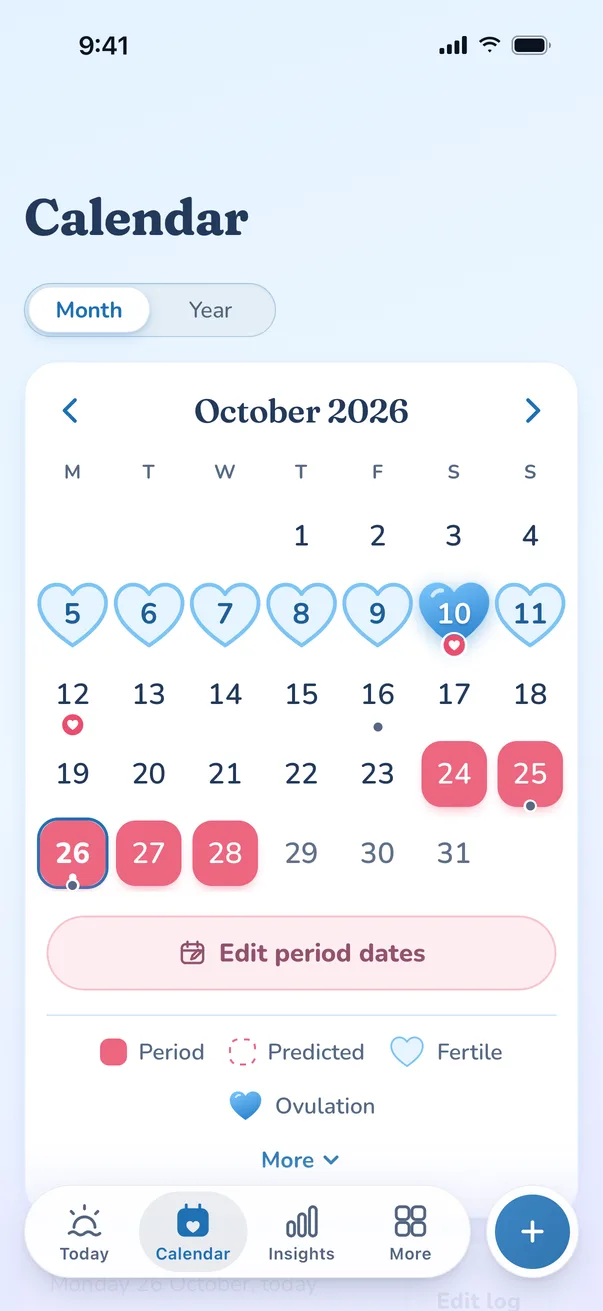

How does the period calculator work?
- Your next period is estimated as your last start date plus your usual cycle length.
- Each later period adds one more cycle. We show a range around every date, and it widens the further ahead we look.
- If you pick "Not sure", we use 28 days (a common average) and show wider ranges.
- If today is past the expected day, we say so and treat your period as "any day now", the same way the Splash app does.
Why we show ranges, not one date
Most period calculators give you a single date and leave you to wonder why your period didn't read the memo. Real cycles wobble by a few days, even for people who'd call themselves regular. A study of more than 600,000 cycles found the average was about 29 days, with plenty of month-to-month variation (Bull et al., 2019).
So each estimate comes with a likely window. It starts narrow and widens the further ahead we look, which is how uncertainty actually behaves.
What a typical period and cycle look like
A cycle is counted from the first day of one period to the day before the next. For adults, cycles of 24 to 38 days are usually considered normal (FIGO, 2018), and in the first few years after periods start, 21 to 45 days is common (ACOG). Most periods last 2 to 7 days (NHS).
| Measure | Usual range | Source |
|---|---|---|
| Cycle length (adults) | 24 to 38 days | FIGO, 2018 |
| Cycle length (teens) | 21 to 45 days | ACOG |
| Month-to-month change | Up to 7 to 9 days | FIGO, 2018 |
| Period length | 2 to 7 days | NHS |
| Average cycle in app data | About 29 days | Bull et al., 2019 |
When to talk to a GP
- Your cycles are often shorter than 21 days or longer than 35 days.
- Your cycle length changes by more than about a week from month to month.
- Your periods have stopped for 3 months or more and you are not pregnant.
- Bleeding is very heavy, lasts longer than 7 days, or happens between periods or after sex.
Not sure whether yours fits? Try is my period normal? or the heavy period checker, and read what counts as a normal cycle length.
Add your estimates to your calendar
The "Add to calendar" button makes a standard .ics file on your device. It works with Apple Calendar, Google Calendar and Outlook. Choose discreet titles if other people can see your calendar: events are then called "Reminder" and say nothing about periods.
Questions people ask
How is my next period calculated?
We add your average cycle length to the first day of your last period. A cycle runs from the first day of one period to the day before the next.
What is a normal cycle length?
For adults, cycles between 24 and 38 days are usually considered normal (FIGO, 2018). In the first few years after periods start, 21 to 45 days is common (ACOG).
Why are the results shown as ranges?
Even regular cycles vary by a few days. A large 2019 study of over 600,000 cycles found the average cycle was about 29 days, but most people's cycles varied from month to month. Ranges are more honest than a single date.
My period is late. Should I worry?
A few days late is common. Stress, illness, travel, weight change and some medicines can all delay a period. If you might be pregnant, take a test. If your period is more than a week or two late, or you're worried, talk to a GP or pharmacist.
Can I use this to avoid pregnancy?
No. Splash is not contraception, and a calendar estimate can't tell you when you are not fertile. If you're avoiding pregnancy, use a method that is contraception.
Is my data saved or sent anywhere?
No. The maths runs in your browser. Nothing you type is stored or sent to us, and the page makes no network requests when you calculate.
Sources
- NHS: Periods
- Munro MG et al. FIGO systems for abnormal uterine bleeding (2018 revision). Int J Gynaecol Obstet
- ACOG Committee Opinion 651: Menstruation in girls and adolescents
- Bull JR et al. Real-world menstrual cycle characteristics of more than 600,000 menstrual cycles. npj Digital Medicine, 2019
- NHS: Irregular periods
Written by the Splash team · Sources checked Oct 2026 · Updated